


One River, One Owner

A water accountability action memo — who controls the Rio Grande in New Mexico, and the single change that puts one authority in charge of the outcome.
By James Prendamano · Owner, PreReal Investments · Board Member, Spaceport America · Sierra County, New Mexico
The white paper laid out seven solutions you can act on now — reclaim the reach, lock in a delivery covenant, request the water held short, establish a minimum pool, manage steady flow, and two more that follow from them. There are others still. But not one of them gets done efficiently until we fix the thing sitting underneath all of them: no single office is accountable for whether the water actually reaches the lake.
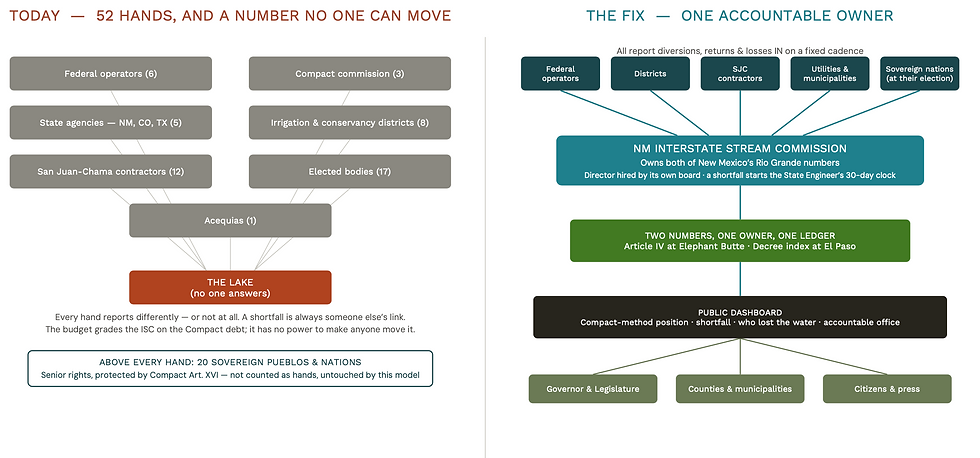
I mapped every government hand on the river from Colorado to Texas — fifty-two of them, federal, state, district, contractor, and elected. What I found is not a shortage of capable people. It is a structure where fifty-two bodies each control a piece of the same river, and not one of them can be made to answer for the outcome. The State already grades the ISC on the Compact debt. This year’s budget target is a debt of 150,000 acre-feet — three-quarters of the way to violation.¹ It is graded on a number it has no power to move. When everyone has a hand in the pot, no one answers for the pot. Above all fifty-two sit twenty sovereign Pueblos and Nations whose rights are senior to every one of them. They are not hands in this count, and nothing here touches their rights.
We don’t need another blue-ribbon panel or another study. We have studied this river to death — the plans, the models, the reports fill shelves. What has always been missing is not analysis. It is an owner and a deadline. The pages that follow are the cost of waiting, how we got here, and the fix. Every fact is sourced; the line-by-line check against the State Water Plan and the full roster sit in the appendices.
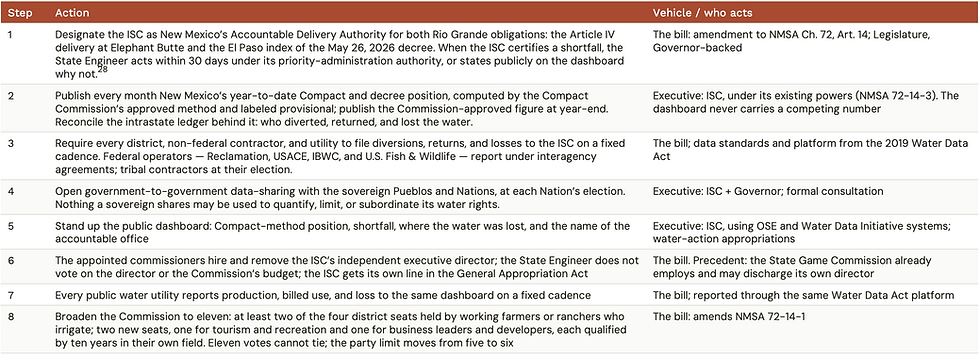
What I am asking for is two moves. First, executive action the ISC can take now under powers it already holds: publish New Mexico’s Compact position every month, open government-to-government data talks, and stand up a public dashboard. Second, one bill amending Chapter 72, Article 14: name the ISC the owner of both of New Mexico’s Rio Grande numbers, require every hand to report, give the Commission a director it hires and fires, put working farmers, the recreation economy, and business at its table, and put the utilities’ losses on the same dashboard. No new agency. No new water right. No act of Congress. Naming the ISC as the lead is the role the State’s own 2023 Water Plan already assigns it. We are not proposing a new plan. We are proposing to finish the one the State already wrote.
— James Prendamano
What Twenty Years Bought Us
The cost of running a river with no one accountable for the outcome — measured in the last two decades.
We had twenty years of drought warnings to get ahead of this, and the record of what that bought is plain: nobody is getting the water. Municipalities are trucking and hauling water in. Farmers have been shorted season after season. Wildlife habitat along the reach has been left to dry and burn. And the reservoir that anchors a regional economy sits at 1.6 percent of capacity.² Two decades of study, and the lake keeps falling.
The harder number is the debt. New Mexico’s accrued debit under the Rio Grande Compact — the running total of water the State owes downstream — stood at about 132,000 acre-feet in April 2026.² The Compact sets a ceiling: New Mexico’s accrued debit “shall not exceed 200,000 acre-feet at any time.”³ We are already two-thirds of the way there.
What happens if we cross 200,000 acre-feet — and why it is the point of no return
The State’s own delivery agencies call exceeding that ceiling “a violation that could result in litigation.”⁴ But the litigation is not the worst of it. The Compact’s machinery is what takes the decisions out of New Mexico’s hands, and that machinery runs at any debit. Under Article VIII, in January of any year Texas can demand — and New Mexico must make — releases from our post-1929 reservoirs, up to the full amount of our debit, at the greatest rate practicable, until Project storage downstream reaches 600,000 acre-feet.³
Texas has already used it: on January 1, 2025, its commissioner called, and between January 3 and 6 New Mexico released all 3,692 acre-feet of debit water it had in storage.⁵ The deeper the debit, the less say New Mexico has over who gets its water and when. Cross the ceiling and New Mexico is in violation of the Compact — and the remedy is written in the U.S. Supreme Court, not in Santa Fe. That is not a fine. That is losing control of the water — who it goes to, and on whose timetable.
The next shoe to drop: fire, then flood, then lives
One cost never shows up in an acre-foot table: fire, then flood. In the dry season, a river that runs empty and fills with dead salt cedar and drought-stressed brush is not just losing water — it is building a fuel load. A U.S. Fish & Wildlife Service case study found that invasive plants and prolonged drought leave the Rio Grande bosque with depleted soils, heavier fuel, and higher wildfire risk.⁶ A dry channel is not empty. It is kindling. We have watched where that leads.
The 2024 South Fork and Salt fires killed people before they were contained. A year later, in July 2025, rain on the South Fork burn scar drove the Rio Ruidoso to a record of more than twenty feet and killed three people, two of them children.⁷ Fire first, then flood, on the same ground and the same families.
The bosque along the Rio Grande carries the same fuel. In 2021, one in five New Mexico wildfires started there.⁶ The work that puts water back in the lake lowers both risks. Clear the reach and you cut the dry-season fuel. Restore the floodplain and the wet-season water has somewhere to go besides through a town. That work has a price, too. Reclamation’s own April 2026 notice counts 214.8 acres of listed-bird habitat lost, partly offset by new habitat, when it closed the low-flow channel’s West gates.² That trade has to be booked — and offset — by one office.
Today it is split among four offices. More than 4,600 people have signed the Elephant Butte Chamber’s conservation-pool petition, warning that wildfire risk will escalate.⁸ That is why this cannot wait.
How We Got Here: Every Law Added a Hand
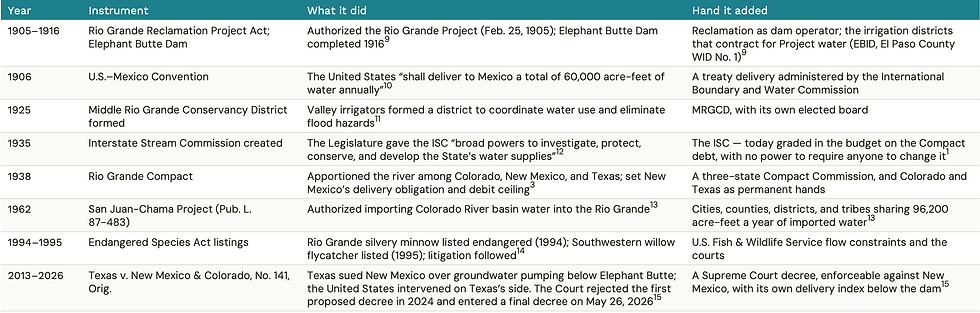
Fifty-two hands did not appear by accident. Each one was added by a law, a treaty, a contract, or a court — for a good reason, one at a time.
No one designed this river to have no owner. It got that way over a century, one instrument at a time. Each fixed a real problem, and each added a hand with its own piece of the water and its own chain of command. Not one of them was written to make anybody answer for whether the water reaches the lake.
The Fix: Who Answers for the Water — Today vs. Tomorrow
Left: the river as it is run now. Right: the same hands, one accountable owner, one ledger, in public.
Why the ISC — Not Reclamation — Sits at the Top
The owner has to be New Mexico’s, it has to be able to act, and it has to answer to someone other than the offices it measures.
The Compact puts the answer in Santa Fe
Reclamation has been floated as a candidate for the top of the funnel. It should not be. Under the Compact, New Mexico is obligated to deliver Rio Grande water as measured at Elephant Butte Reservoir — the Supreme Court’s own decree says so.¹⁵ The last time the Compact’s division of this river was litigated, over groundwater pumping below the dam, Texas sued the State, the United States intervened on Texas’s side, and it took thirteen years and a Supreme Court decree to settle. That decree names the State — not a district, not an agency — as the party that must comply.¹⁵
Reclamation answers to the Interior Department and Congress, not to the Governor. Put Reclamation on top, and New Mexico hands its own accountability to the same federal government that sat on the other side of that case. The United States has since settled its claims against New Mexico, and Reclamation’s releases feed the decree’s index.⁵ That is a reason to make it the State’s reporting partner. It is not a reason to make it the State’s owner. The ISC keeps the answer in Santa Fe, where the Compact puts it, using powers it already holds under NMSA 72-14-3.¹⁶ Reclamation runs the dams; the State owns the outcome.
It has been done before
Australia faced the same structure on the Murray–Darling: one river system, several states, each managing its own piece, and a basin its own law describes as “overallocated or overused.” In 2007 it passed the Water Act, which set up the Murray–Darling Basin Authority — a body its government called “independent” — and charged it with one Basin Plan and enforceable diversion limits for the whole basin. In 2008, after the basin states referred powers to the national government, the old multi-state commission was abolished and its powers folded into the Authority.¹⁷
Then Australia learned the second lesson. In 2019 a Royal Commission found officials had committed “gross maladministration, negligence and unlawful actions” in drawing up the plan, and in 2021 Australia added an independent Inspector-General of Water Compliance to police it.¹⁷ One owner is the fix. Independence in fact is what keeps the owner honest. Australia had to move that authority up to the national government to get it. New Mexico does not. We can get the same single owner by naming a body we already have — without ceding anything to Washington.
An Owner That Answers to Its Own Board
Naming the ISC is necessary but not sufficient. The Legislature fixed half of the Commission in 2023. This finishes the job.
Today the ISC is the State Engineer plus eight commissioners the Governor appoints with Senate consent. In 2023 the Legislature rebuilt that board with qualification requirements, staggered four-year terms, and removal only for cause.¹⁸ It stopped halfway. The ISC’s director is still named by the Governor and also serves as an assistant State Engineer — inside the office the Commission is meant to hold to account.¹⁹ That office has used that position before. In 2017 the State Engineer fired the ISC’s director; longtime commissioners resigned, describing a State Engineer “trying to take over and be totally in control of the ISC,” and then-House Speaker Brian Egolf, a water lawyer, admitted that because every member is appointed by the Governor, the Commission can’t really be considered “independent.”²⁰ The 2023 reform answered half his point. The director is the other half. Seat the Commission at the top of the funnel as it stands, and every delivery decision still routes back through the office whose performance it is supposed to measure. The accountability would be on paper only.
So naming the ISC comes with its structural fix: the appointed commissioners hire — and remove — their own independent executive director, and the State Engineer does not vote on the director or the Commission’s budget. The Commission gets its own line in the General Appropriation Act, so a director who cannot be fired cannot be starved either. An independent director can set delivery policy and enforce reporting on the river’s calendar, not the election calendar, and cannot be removed for refusing an order from the office being measured. That is the difference between an owner who answers for the number and a staffer who serves at the pleasure of the people the number judges. New Mexico already does this. The State Game Commission “shall employ a director” and “may at any time discharge the director,” and the Wildlife Commission still hires its director today.²¹
Independence fixes who the director answers to. The board also has to reflect who lives with the result. Today’s eight seats go to four district representatives, an acequia, a drinking-water utility, and two academic or technical experts, and every appointee needs ten years in water.¹⁸ No seat requires a working farmer. No seat speaks for the recreation and tourism economy that lives or dies on the lake level. No seat speaks for the people who build and invest in the towns along the river.
The bill changes that: at least two of the four district seats go to working farmers or ranchers who irrigate, and two new seats go to tourism and recreation and to business leaders and developers, each qualified by ten years in their own field. That makes ten appointees and the State Engineer, eleven votes, so the board cannot tie, and the party limit moves from five to six. Water expertise stays on the Commission. The people who pay for a dry river get a vote on it.
Authority acts when it’s popular. Accountability has to act always.
The State already knows how to act when it chooses to. This year the State — through the State Engineer — sued the federal government for drilling wells and taking New Mexico’s groundwater for border-wall construction; the Governor called it water “being stolen by the federal government,” and the State Engineer demanded “double repayment for all illegally diverted groundwater.”²² That is the right posture.
Now compare River Mile 60. Reclamation built the low-flow channel and, with MRGCD, the River Mile 60 outfall. MRGCD asked to take over operation of the channel’s lower reach this year. The ISC asked MRGCD to pursue that transfer to cut the Compact debt.²³ The State Engineer holds the permit law. Four offices touch the same water. When senior water-right holders alleged that federal ponds there were depleting it, they had to sue the State Engineer to get an answer.²⁴ Reclamation closed the West gates on April 10, 2026, and cited the Compact debt when it did.² The ISC is already at the table on this water. It does not have the authority to answer for it. That is the job this memo gives it. Citizens should never have to sue the State to get an answer about the State’s own water.
The Water We’re Already Losing
The cheapest new source of water in New Mexico is the water we already pump and then lose — and the same accountability fix reaches it.
While we argue over acre-feet at the dam, we are pouring treated, paid-for water into the ground through pipes no one is accountable for. Truth or Consequences — the town at the edge of the reservoir — lost 43 percent of its water in 2022, more than 200 million gallons, to leaks. Three years earlier the loss was 28 percent, so it is getting worse, not better.²⁵ Roughly half the city’s supply lines are more than fifty years old; some date to the 1930s.²⁵ The Legislature’s own case study logged 376 pipe leaks or breaks in a single nine-month stretch.²⁶ A lake at 1.6 percent sits next to a town losing nearly half of what it pumps. That is not only a drought problem. It is an accountability problem.
Treat leaks as what they are: a new source of water. The State’s own 50-Year Water Action Plan already counts reducing drinking-water leaks and municipal conservation among strategies worth on the order of 660,000 acre-feet a year — water we could keep without building a single new project.²⁷ Truth or Consequences alone will spend north of 25 million dollars in state money to replace a fraction of its lines.²⁶ The water is right there, under the street. What is missing is the same thing missing at the dam: no one is answerable for the number, and no one has to show it in public.
Extend the dashboard to the last mile
The fix is the same principle carried down to the municipal system. Every water utility — especially the small ones — reports its production, its billed use, and its loss into the same public dashboard the ISC stands up for delivery. Water in, water billed, water lost, updated on a fixed cadence, posted for anyone to see. When a town is losing 43 percent of its water, the public should not have to file a records request to learn it. Public loss reporting does two things at once: it turns an invisible leak into a visible number a mayor has to answer for, and it puts a real, recoverable source of water back on the table. No one hides ineffective management behind a meter no one reads. That is Step 7.
What It Takes to Seat the ISC at the Top
Eight steps. Three are executive action the ISC can take now; five ride on one bill amending Chapter 72, Article 14. No new agency. No act of Congress.
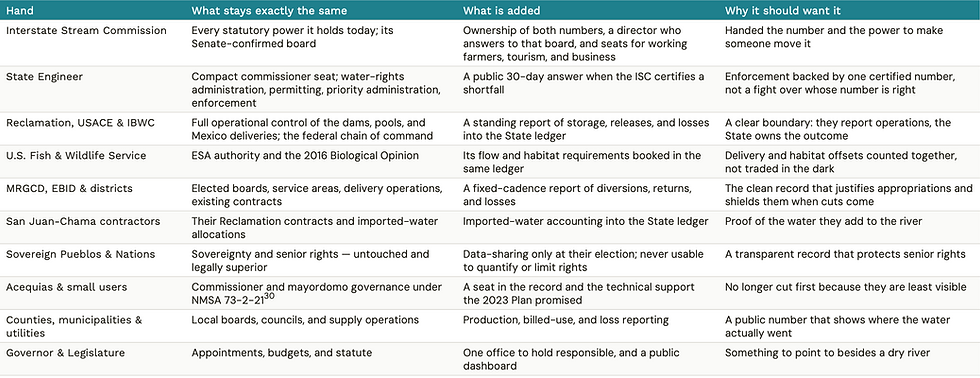
What Every Hand Keeps, Adds, and Gains
This does not put anyone on trial. It gives every hand the record that proves its worth.
For decades, staying invisible was safe. No number to miss, no shortfall with your name on it. That has flipped. With the lake near empty and the public watching, “we all share responsibility” now reads as “nobody is responsible” — and that is the line that gets budgets cut. When the reckoning comes, the axe falls on whoever cannot show what they delivered, not on whoever reported clearly. The dodge is now the risk.
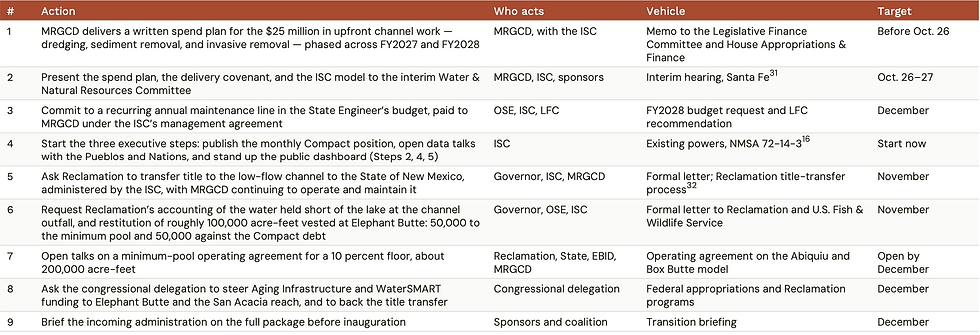
The Roadmap: What Happens, Who Acts, and When
Every action from the white paper and from this memo, in the order the calendar sets. One agency administers all of it.
The model for the low-flow channel is simple. The State takes title. MRGCD keeps maintaining and operating it: it has run the channel from San Acacia to its southern boundary since August 2021, and this year it asked to take over the lower reach.²³ ³² The only change is that the federal layer comes out. The ISC is the one accountable agency. It administers the title for the State, runs MRGCD’s management agreement and delivery covenant, disburses the money, and answers on the dashboard for every item below. Reclamation can now transfer title without a separate act of Congress.³² The State needs one change of its own: the ISC’s current powers do not expressly cover accepting title to the channel, so the bill authorizes it.¹⁶
The Roadmap: The Legislation and the Year After
Four pieces of legislation in the 2027 session, then the work they fund. The ISC answers for each one.
The 2027 session runs 60 days. Bills may be prefiled January 4–15, the session opens January 19, the introduction deadline is February 18, it adjourns March 20, and the Governor acts by April 9.³¹ All four pieces below are prefiled.
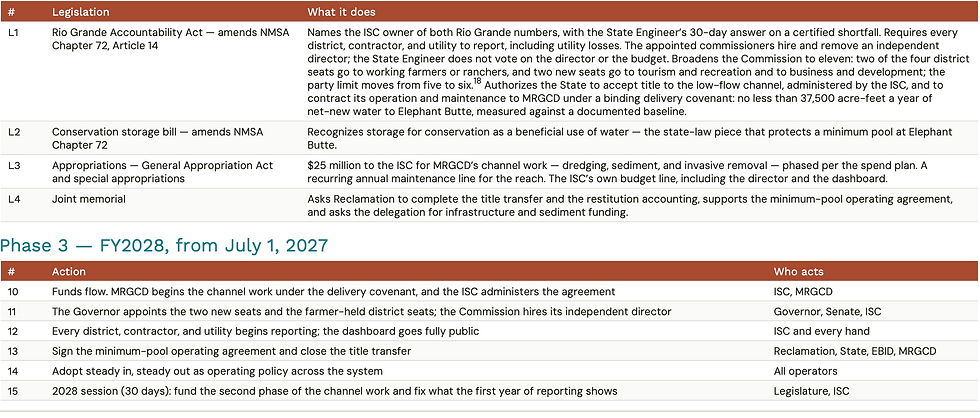
Every step above has an owner, a vehicle, and a date. None needs a new agency or an act of Congress. It needs the decision to start. The ones who can show what they delivered will keep their budgets. This is a way for every hand on the river to be in that group. That is the ask: one river, one owner. Not one hand fewer on the work — one office finally answerable for the result, and structured so it can answer honestly.
— James Prendamano
Appendix A — Checked Line by Line Against the 2023 State Water Plan
The 2023 State Water Plan (5-Year Review), read end to end. Where the model and the Plan line up, in the Plan’s own words.
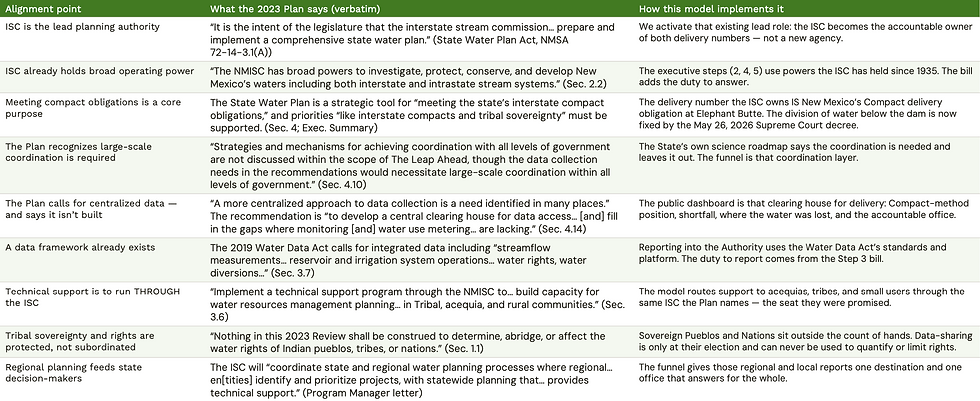
On every point where the 2023 Plan states an intention — a lead authority, coordinated government, centralized data, technical support through the ISC, protected tribal rights, compact compliance — it stops at the intention. This model is the mechanism. It does not replace the Plan; it makes the Plan operational.²⁹
Appendix B — Every Hand
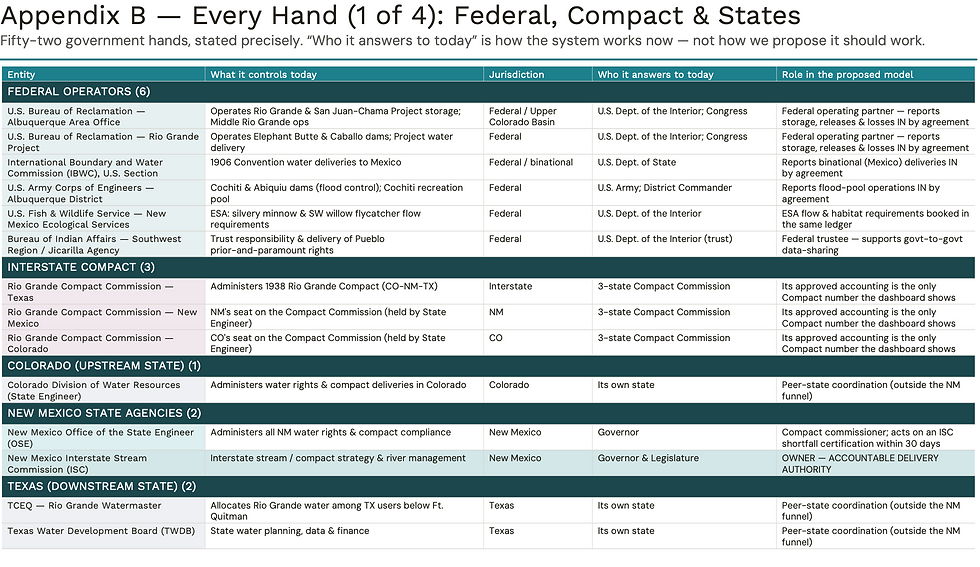
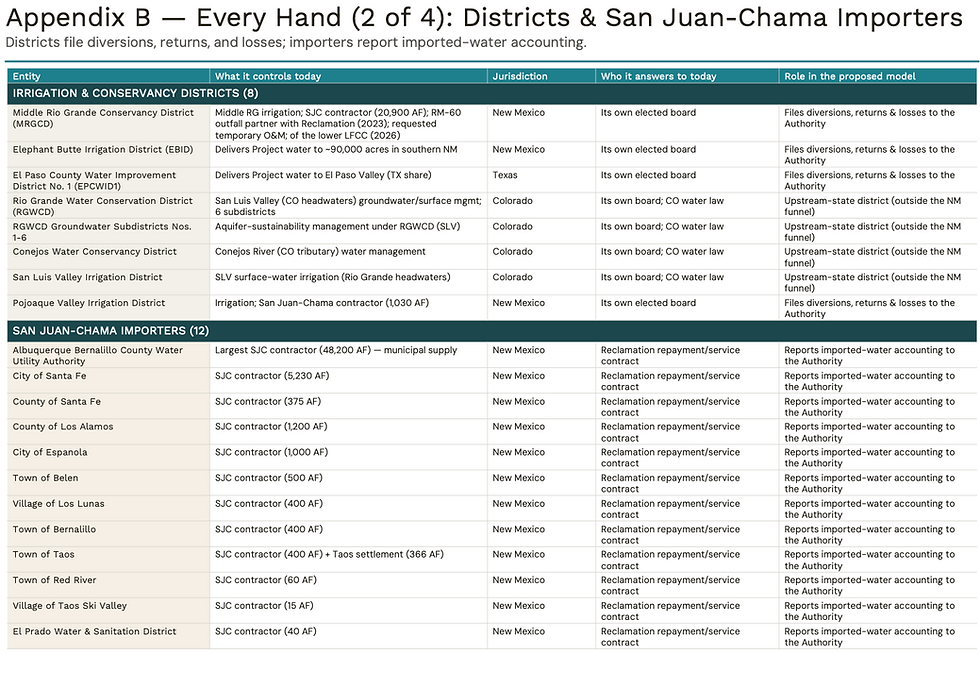
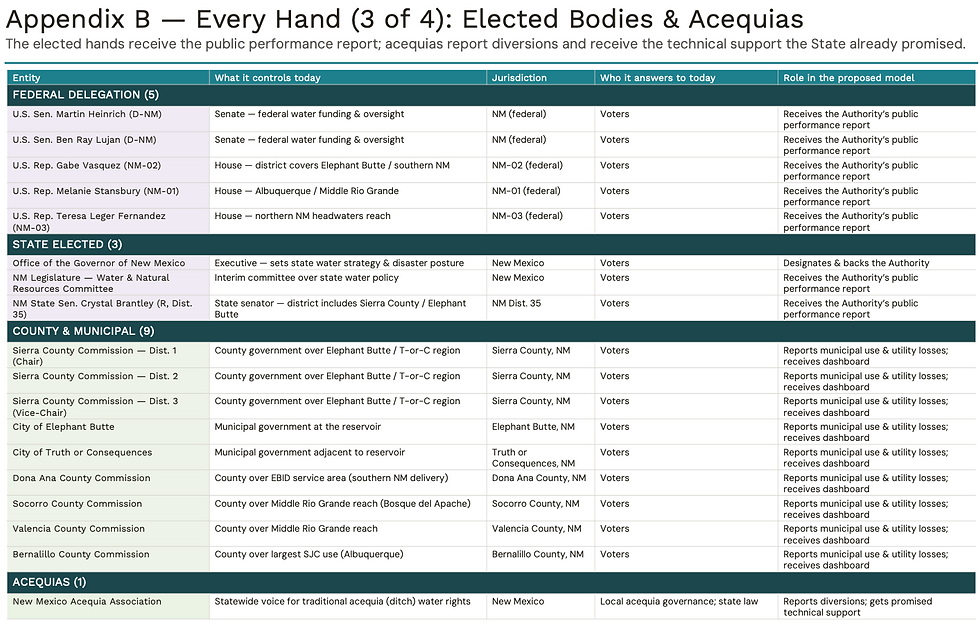
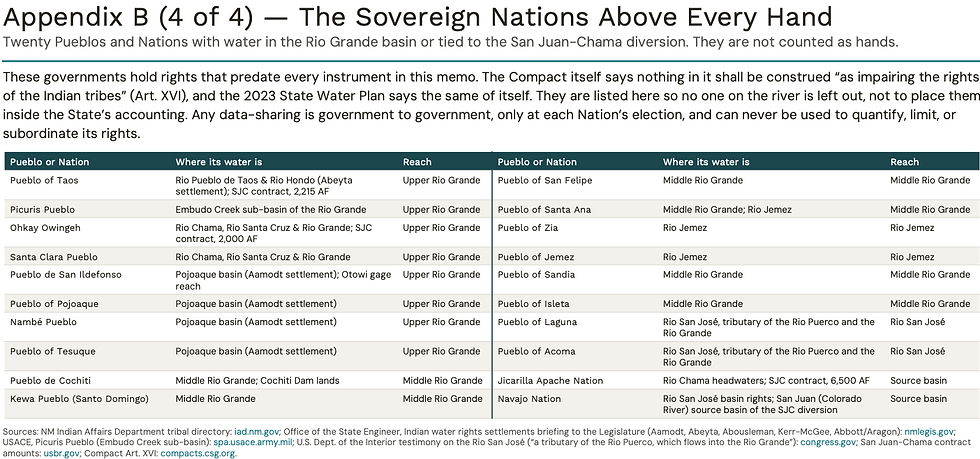
Sources
Numbered to match the footnotes. Every link verified live on September 25, 2026.
1. FY2026 General Appropriation Act (HB 2), State Engineer, Interstate stream compact compliance program: Rio Grande compact delivery-credit target of −150,000 acre-feet: nmlegis.gov
2. Elephant Butte storage, 32,915 acre-feet on Sept. 24, 2026: Reclamation daily storage data: usbr.gov; 1.6 percent of conservation capacity on Sept. 24, 2026 (same Reclamation gauge): Texas Water Development Board: waterdatafortexas.org; Reclamation Albuquerque Area Office, RM-60 LFCC West Gates closure memo, Apr. 10, 2026 (debit at 132,000 AF; 214.8 acres habitat loss, 40.1 net; closure reasons) — on file.
3. Rio Grande Compact (1938), Arts. IV, VI, VIII, XVI: compacts.csg.org
4. NM Interstate Stream Commission & MRGCD, Rio Grande Compact Fact Sheet: mrgcd.com
5. Reclamation, Calendar Year 2025 Report to the Rio Grande Compact Commission: usbr.gov
6. U.S. Fish & Wildlife Service, “Goats as a Tool for Fire Management” (Rio Grande bosque case study): fws.gov
7. 2024 South Fork & Salt fires: Source New Mexico: sourcenm.com; July 2025 Ruidoso flood: Associated Press: apnews.com
8. Elephant Butte Chamber of Commerce, “Establish a Conservation Pool at Elephant Butte Dam” petition: change.org
9. Rio Grande Project history: Western Area Power Administration: wapa.gov; EBID history: NMSU Cooperative Extension: pubs.nmsu.edu
10. Convention between the U.S. and Mexico (1906), Art. I: ibwc.gov
11. Reclamation, Middle Rio Grande Project history: usbr.gov
12. NM Office of the State Engineer, FY2023 State-Tribal Collaboration Act Annual Report: iad.nm.gov
13. Reclamation, San Juan-Chama Project: usbr.gov
14. NM Office of the State Engineer, Rio Grande ESA background: ose.nm.gov
15. Texas v. New Mexico, 602 U.S. (June 21, 2024): supremecourt.gov; U.S. intervention: Legal Information Institute: law.cornell.edu; Final Decree, Texas v. New Mexico, 608 U.S. (May 26, 2026): supremecourt.gov; Order List, May 26, 2026: supremecourt.gov
16. ISC powers, NMSA 72-14-3: law.justia.com
17. Australian Dept. of Environment, Water, Heritage & the Arts, submission to Senate inquiry (2009): aph.gov.au; Senate Legal & Constitutional Affairs Committee report (2008 referral; Water Amendment Act 2008): aph.gov.au; Water Act 2007 (Cth), ss. 3, 171: mdba.gov.au; Royal Commission findings: ABC News, Jan. 31, 2019: abc.net.au; Inspector-General of Water Compliance: igwc.gov.au
18. SB 58 (2023), NMSA 72-14-1 as reenacted: nmlegis.gov; NMSA 72-14-1 (membership, qualifications, party limit): law.justia.com
19. “Governor announces new director of the Interstate Stream Commission,” NM Political Report, July 6, 2023: nmpoliticalreport.com
20. “Interstate Stream Commission resignations reveal conflict with state’s water boss,” NM Political Report, Oct. 13, 2017: nmpoliticalreport.com
21. NMSA 17-1-5: law.justia.com; NM State Wildlife Commission: wildlife.dgf.nm.gov
22. State Engineer’s border-wall groundwater suit: Newsweek: newsweek.com
23. Reclamation, EA/FONSI, Temporary Transfer of LFCC O&M, June 2026: usbr.gov; MRGCD FY2024 financial report (RM-60 outfall partnership, 2023): mrgcd.com
24. Haynes Revocable Trust et al. v. NM Office of the State Engineer, No. D-725-CV-2025-00139 (7th Jud. Dist., filed July 3, 2025); allegations, not findings — complaint on file: nmcourts.gov
25. Searchlight New Mexico, “In drought-plagued New Mexico, a city loses nearly half its water to leaky pipes”: searchlightnm.org
26. NM Legislative Finance Committee, Policy Spotlight: State-Funded Water Projects: nmlegis.gov
27. Governor’s 50-Year Water Action Plan: nm.gov
28. Priority administration, NMSA 72-2-9.1: law.justia.com
29. NM State Water Plan, 2023 5-Year Review (NMSA 72-14-3.1): mainstreamnm.org
30. Acequia governance, NMSA 73-2-21: law.justia.com
31. 2027 session dates (prefiling Jan. 4–15; opening Jan. 19; introduction deadline Feb. 18; adjournment Mar. 20; Governor’s action deadline Apr. 9): NM Legislature: nmlegis.gov; Interim Water & Natural Resources Committee: nmlegis.gov
32. Reclamation title transfer; Dingell Act (P.L. 116-9), Title VIII, transfers “without separate and individual acts of Congress”: usbr.gov; Reclamation LFCC briefing to the Legislature: MRGCD has operated and maintained the LFCC from San Acacia to its southern boundary since Aug. 1, 2021; changes require written U.S. authorization; title remains federal: nmlegis.gov
Roster (Appendix B). Reclamation Albuquerque Area Office: usbr.gov; USACE Cochiti: spa.usace.army.mil; MRGCD financial report: mrgcd.com.


Comments